
The 12-Point Self-Editing Checklist for Your First Draft
A practical, ordered self-editing checklist for a finished first draft: structure, pacing, repetition and prose tics, with a twelve-point list to work through before anyone...
Finishing a first draft is a strange kind of relief. You type the last line, close the laptop, and for about an hour you feel magnificent. Then you open the file again and discover that chapter nine consists of two people agreeing with each other for three pages, that your protagonist has "just" done something on almost every page, and that a minor character introduced in chapter two has quietly vanished by chapter six.
None of that means the draft is bad. It means it is a draft. What separates writers who finish from writers who rewrite forever is sequence: big questions first, small ones last. Fix a sentence you are later going to delete and you have thrown an afternoon away. Edit in the wrong order and you will spend three hours polishing a paragraph that belongs in a different chapter — or in the bin.
Before the Checklist: Read Without Fixing
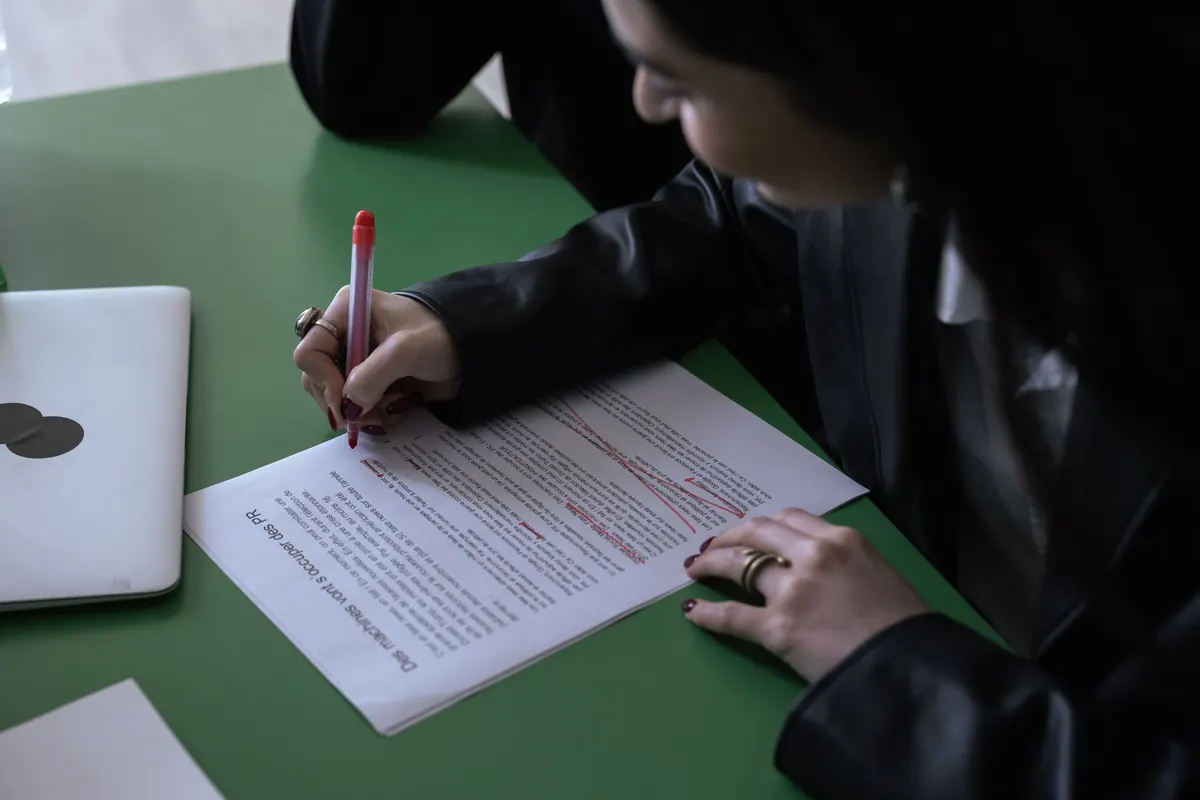
Read the whole thing once and touch nothing. If you can, change the format — print it, or read it on a different device in a different font — so it stops feeling like yours. A printed page is humbling in a useful way; lines you skimmed on screen become obvious.
You are hunting for three things only: where you get bored, where you get confused, and where you stop believing. Mark them in the margin. Do not repair them yet. The urge to stop and polish a paragraph is the main reason self-editing takes a month rather than a weekend. Keep a separate notebook or a blank document for fixes you cannot resist writing down, then move on.
If you can leave the draft alone for a week before this read, do. Distance is the cheapest editing tool you own. Failing that, work on something else for a few days, or read the draft at a different time of day than you wrote it.
The Structure Pass
1. Does the story start in the right place? First drafts usually begin one or two chapters too early. Ask what the reader genuinely needs before the inciting incident, then look for a way to deliver it inside movement rather than in a warm-up scene. If your opening chapter is a tour of the protagonist's ordinary life, try starting at the moment the ordinary life cracks.
2. Does every scene change something? Something should be different at the end: what a character knows, what they want, who they trust, what they have lost. If you can delete a scene and nothing shifts, either cut it or fold its one useful moment into a neighbouring scene. A scene where two characters agree about the plot is not a scene; it is a summary wearing a costume.
3. Does the ending answer the question the opening asked? It does not need to resolve every thread — untidiness is often honest — but the central question must be answered, and the answer should cost something. If the opening asks whether she can forgive her brother, the ending cannot simply reveal that the brother was innocent all along. That answers a different question.
The Pacing Pass
4. Cut into scenes late and leave early. The first line or two of most draft scenes is throat-clearing: arrivals, greetings, weather, people sitting down. Find the moment the scene truly begins and start there instead. The last line is often a character walking out of the room; cut before they reach the door.
5. Look hard at how chapters end. An ending that ties everything off gives the reader permission to put the book down. That is fine occasionally, but if every chapter closes neatly, the middle will sag. End on a question, a decision, a small disturbance. Let the reader carry something into the next chapter.
6. Check the balance of scene and summary. A fistfight deserves real time; a fortnight of travel can be a sentence. Drafts tend to do the opposite, dramatising the dull parts and skipping the ones that matter. If you have written 800 words about packing a suitcase and one line about the funeral, your priorities have slipped.
The Repetition Pass
7. Hunt your crutch words. Use the search function and count them honestly. Usual suspects: just, very, really, suddenly, actually, seemed, began to, somehow. Then check your action tics: nods, smiles, sighs, shrugs, raised eyebrows, deep breaths. Characters in first drafts are exhausting company. One raised eyebrow is a gesture; four is a medical condition.
8. Look for information you have told the reader twice. You remember it because you wrote it; they only need it once, at the moment it matters. The same goes for imagery — three water metaphors in four pages is two too many. If you have already explained that the city is corrupt, you do not need a second paragraph explaining it again with different adjectives.
The Prose Tics Pass
9. Remove filter words. "She saw a man in a grey coat standing by the gate" is weaker than "A man in a grey coat stood by the gate". He noticed, she realised, he felt, she watched — most of them can go, and the sentence gets closer and faster. Filter words remind the reader that someone is reporting the scene rather than letting them stand inside it.
10. Put the weight in the verb. Adverbs propping up flat verbs ("walked quickly", "said angrily") usually point at a verb that already exists. Watch abstract nouns doing a verb's job, too: "made a decision", "had an argument", "came to a realisation" all have leaner forms. He decided. They argued. He realised. The sentence loses weight and gains force.
The Line-Level Pass
11. Vary your sentences. Read a page aloud. If every sentence opens with a subject and runs to a similar length, the prose will tick like a metronome. Break one. Let a short one land. Follow a long, winding sentence that gathers clauses like a coat gathers lint with a three-word sentence that stops the reader cold.
12. Check dialogue and consistency. Do your characters sound different from each other, or is everyone witty in the same way? Cover the names and see if you can tell who is speaking. Check that eyes stay the same colour, that the season does not jump from autumn to spring, and that a character who cannot swim in chapter three does not casually dive into a lake in chapter ten. Continuity errors are not moral failures; they are what second reads are for.
The Read-Aloud Pass
Once the twelve points are done, read the manuscript aloud — or use a text-to-speech tool and listen. Your ear catches what your eye forgives. You will hear sentences that run out of breath, dialogue that sounds like a press release, and repeated rhythms you never noticed on the page.
Mark every place you stumble. You do not have to fix it immediately; just note whether the problem is a missing word, an awkward clause, or a paragraph that should not be there at all. This pass is especially useful for openings and endings, where the reader's attention is most fragile.
If reading aloud feels unbearable, that is information too. It usually means the prose is doing more work than the story. Go back to the structure pass before you touch another comma.
When to Stop Editing and Show Someone
Self-editing has a point of diminishing returns. You will reach a stage where you can no longer see the draft clearly — where you have read the same paragraph so many times that the words have turned into shapes. That is the moment to stop.
Give the manuscript to one or two trusted readers. Ask specific questions rather than "Is it good?" Try: Where did you get bored? Where were you confused? Did the ending feel earned? Did any character seem to change personality without reason? Specific questions produce specific answers, and specific answers are the only kind you can use.
Then put their notes beside your own and look for overlaps. If two readers flag the same scene, they are probably right. If one reader hates a character everyone else loves, that may be taste rather than a problem.
Editing is not a punishment for writing a bad draft. It is the work of finding the book that was hiding inside the draft you wrote.
Work through the passes in order, resist the urge to polish too early, and give yourself permission to stop when the pages are clear enough for someone else to read. A first draft gets you to the end. Editing gets you to the beginning of the real book.
Photo: cottonbro studio / Pexels